
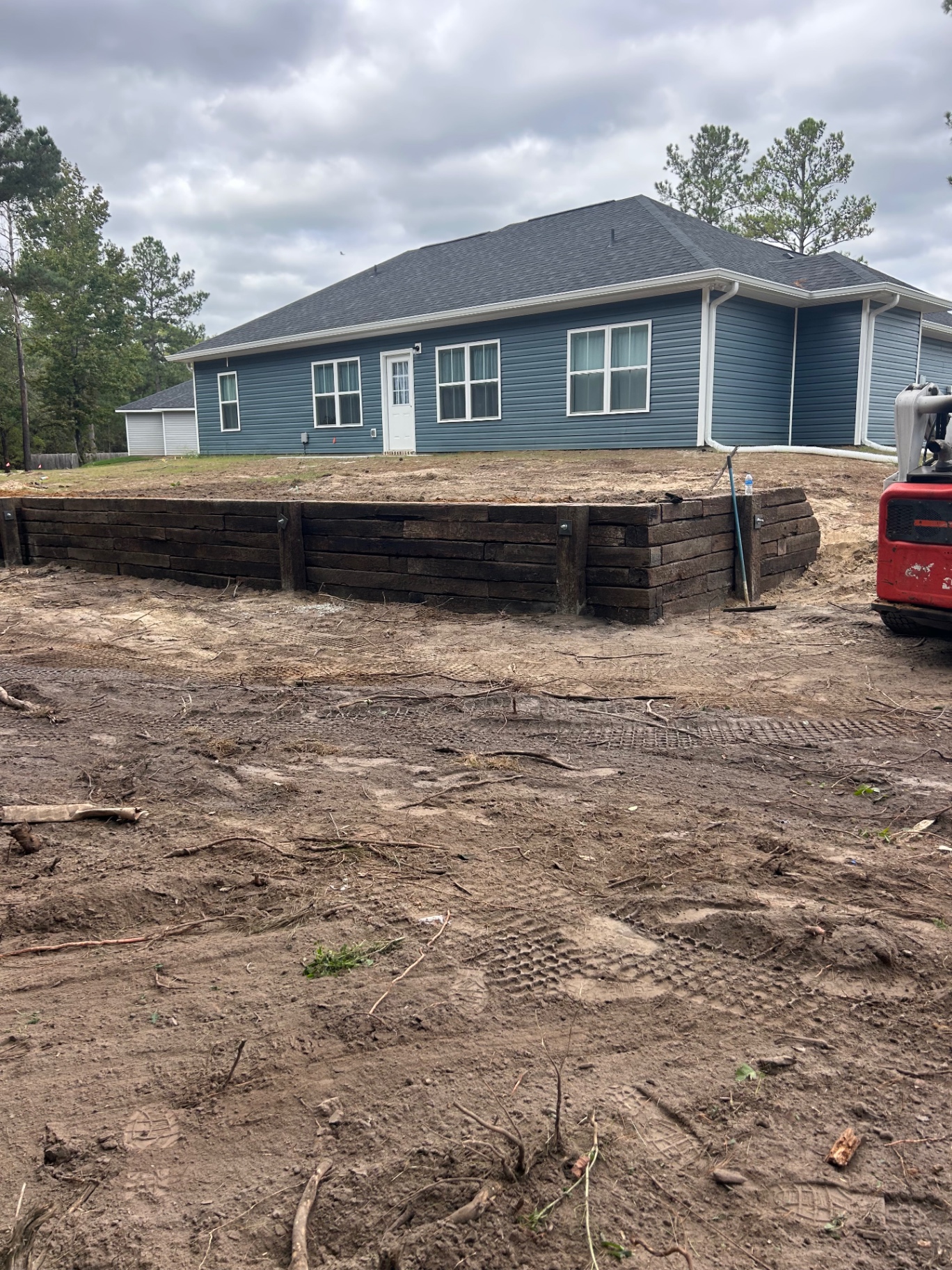
Retaining Wall Installation
Built on a real base with drainage behind it, so it does not lean.
What Retaining Walls Involves
A retaining wall holds back dirt that wants to move. Get the base and the drainage right and it lasts decades. Skip either one and it leans out in a couple of years.
We build block walls, timber and crosstie walls, and stone walls. Which one fits depends on the height, the load behind it, and what the property looks like.
When You Need Retaining Walls
- A slope is eroding or sliding toward the house or driveway.
- You want usable flat yard on a lot that falls off.
- A grade change has to be held between two properties.
- An old wall is leaning, bowing, or coming apart.
- A driveway or patio needs the bank held back beside it.
Common Retaining Walls Projects
- Segmental block retaining walls
- Crosstie and timber walls
- Terraced walls on steeper slopes
- Walls along driveways and parking areas
- Replacement of failed or leaning walls
- Wall and grading combination to level a back yard
How We Handle the Job
- 1
Check the load
We look at wall height, slope above it, and whether anything heavy sits behind it.
- 2
Dig the base
The trench goes below grade so the bottom course is buried and anchored.
- 3
Set the base course
Compacted stone base, then the first course set level. Everything above depends on this.
- 4
Build and backfill
Courses go up with drainage stone and fabric behind as we climb.
- 5
Drain and cap
Pipe carries water out at the ends, then the wall gets capped and the grade tied in.
Equipment We Use
- Compact excavator for base trench and backfill
- Skid steer for setting block and moving material
- Plate compactor for base and backfill lifts
- Laser level for course control
Why Experience Matters Here
Nearly every failed wall we replace failed for the same two reasons. No drainage behind it, and a base that was never compacted. Water pressure behind a wall is enormous.
Walls over about four feet start needing engineering and sometimes geogrid. We will tell you when your project is in that range instead of stacking block and hoping.
Retaining Walls Questions We Get Asked
How tall can a retaining wall be without engineering?
Most jurisdictions around here let you build up to about four feet before an engineered design is required. Above that, or with a slope or driveway above the wall, plan on engineering.
Do retaining walls need drainage?
Yes, every time. Drainage stone, filter fabric, and a pipe at the bottom. Without it, saturated soil pushes the wall out and no amount of block will hold it.
Block, timber, or stone?
Block is the most durable and the most common. Timber and crosstie cost less up front and look right on rural property, but they have a shorter life. Stone is the priciest and best looking.
Can you fix a wall that is already leaning?
Sometimes the top can be rebuilt, but if the base or drainage failed, a rebuild is the honest answer. We will tell you which one you are looking at after we dig behind it.
Where We Do Retaining Walls Work
We cover all of Coastal Georgia for retaining walls, including Midway, Hinesville, Richmond Hill, Savannah, Pooler, Ludowici, and Pembroke, plus Liberty, Bryan, Chatham, and McIntosh County.
Need Retaining Walls in Coastal Georgia?
Call or send us the details and we will get you a straight estimate.